How to Automate Public Hiring Processes Without Losing Required Transparency
Introduction
There is a persistent myth in the public and hybrid sector: that automation and transparency are opposing forces. The idea is that speeding up selection with technology would cost the entity the control and traceability the law requires. The truth is the opposite. Applied well, automation is transparency's strongest ally—because it replaces manual, fallible recordkeeping with an automatic, complete trail.
Are automation and transparency compatible?
Yes—and more than that, they are complementary. Transparency requires every decision to be documented, traceable, and justifiable. That is precisely the kind of task where humans fail and systems shine. The mistake is confusing automation with outsourcing the decision. Automating is not letting the machine choose the candidate; it is letting the machine record and standardize the process while the decision remains human and reasoned. Central principle: automate the process and the documentation; keep the decision human. That boundary is what delivers efficiency without undermining the principles of impersonality and reasoned justification.
The pillars of automation compatible with public compliance
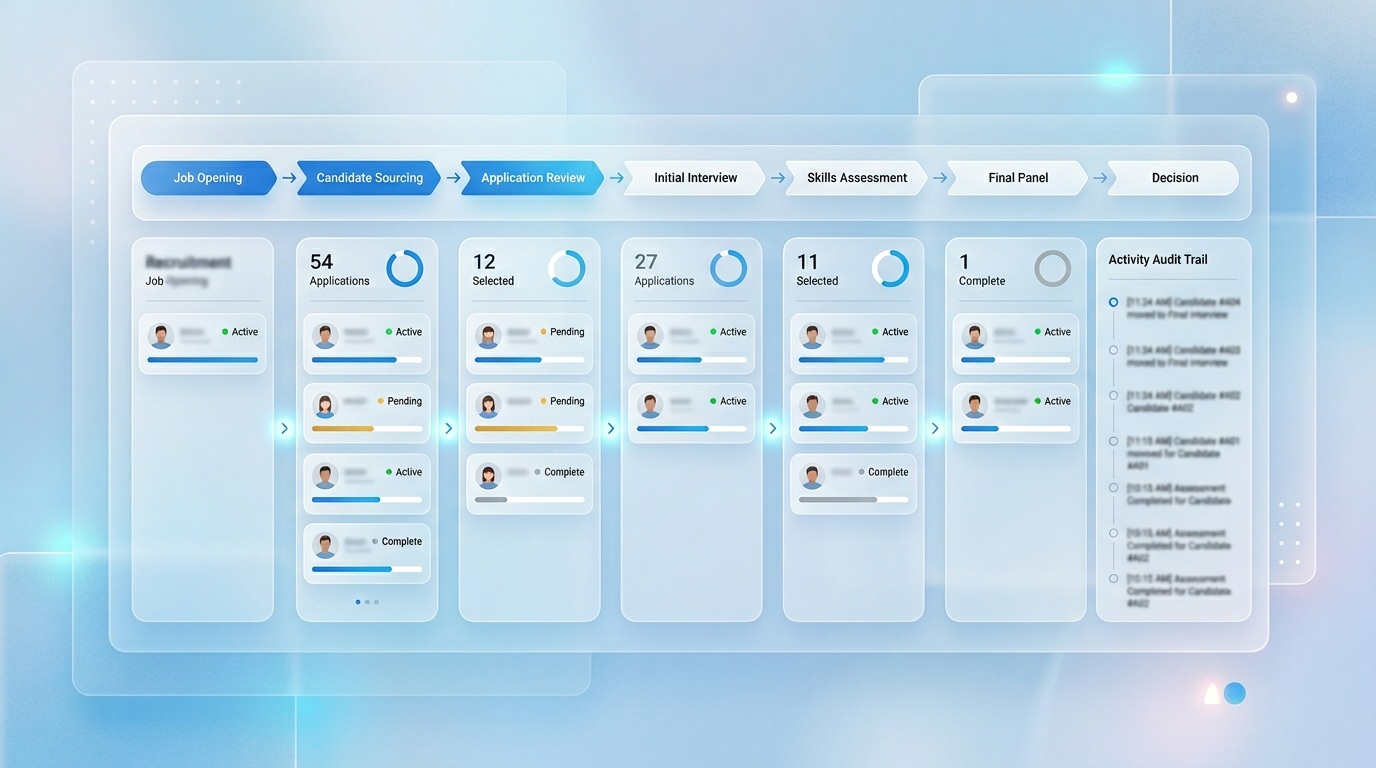
1. Objective, configurable criteria before the vacancy. Automation is only transparent if the criteria it applies are defined in advance and visible. An automatic filter no one can explain is as problematic as an arbitrary choice. The rule: if the system eliminates a candidate, there must be a public criterion that justifies the elimination. 2. Tamper-resistant audit trail. Every action in the process (criteria change, score entered, candidate eliminated, decision made) must generate a record with author, date, and content that cannot be erased without leaving a trail. That is the backbone of automated transparency. 3. Explainability of decisions. Every elimination and every approval needs a recoverable reason. The system must make it possible to answer, at any time: why did this candidate advance and that one not? Without that explainability, automation becomes a black box—exactly what oversight rejects. 4. Segregation of duties and access profiles. Who configures the vacancy, who evaluates, and who approves should have distinct roles in the system. Well-designed access profiles digitally reproduce the separation of responsibilities that compliance requires.
Concrete benefits of responsible automation
• — Shorter time to hire, without compromising the record.
• — Full standardization, with all candidates treated under the same criteria.
• — Accountability in minutes, with reports generated from the audit trail.
• — Lower risk of findings, because documentation is complete by design.
• — A more professional candidate experience, which strengthens the entity's employer brand.
How to move from manual to automated without adding risk
Map the current flow and identify where documentation is lost today. Formalize criteria and stages in a workable regulation. Choose a platform with a native audit trail—not a system that only organizes résumés. Implement access profiles that reflect segregation of duties. Run an auditable pilot and validate the reports before scaling. Responsible automation does not weaken control—it industrializes it. Instead of depending on each manager's memory and discipline, the entity gains a process that documents every decision on its own.
Meet Plooral's Transparency Mode
Plooral's Transparency Mode turns every stage of recruiting into an auditable record: objective criteria defined before the vacancy opens, traceable scoring for each candidate, an automatic audit trail, and reports ready for accountability. It is how you combine private-sector agility with the legal certainty expected of Sistema S, Social Organizations, and supervised entities. Schedule a demo and see how Transparency Mode can support management of your organization's selection processes.
Want to see Plooral in action?
Schedule a personalized demo and learn how to organize your recruitment processes.
Schedule a demo